
1. Problem Snapshot
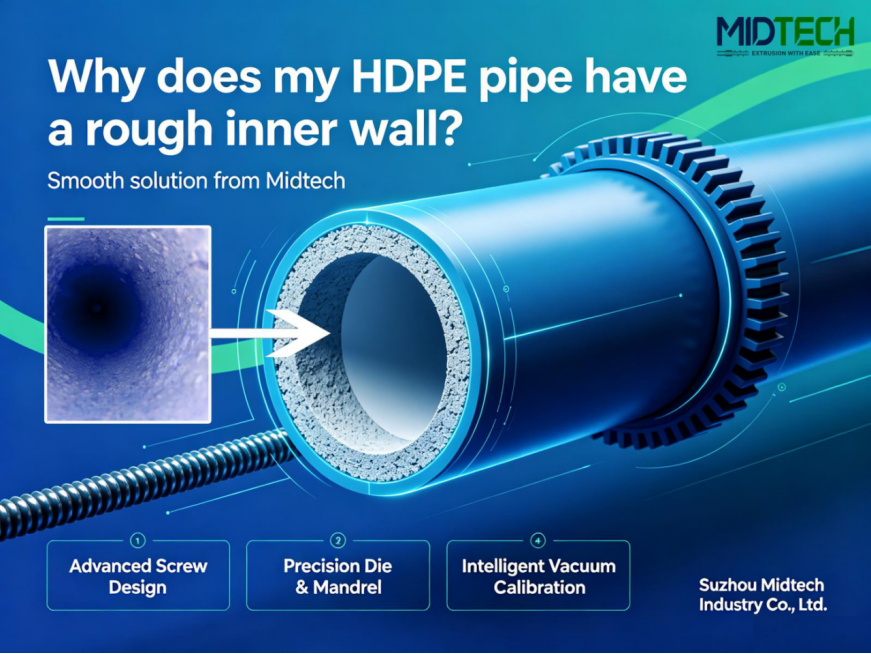
If you’re asking “Why does my HDPE pipe have a rough inner wall?” , you’ve likely seen:
● Shark skin / orange peel
● Longitudinal grooves or jitter rings
● Localized rough spots or dull finish
These defects directly impact pipe performance and customer trust.
2. Key Causes–Briefly
A rough HDPE pipe inner wall usually comes from one of these areas:
● Melt quality–incomplete plasticization, melt fracture, uneven temperature
● Die & mandrel–rough surface, incorrect gap, short land, misalignment
● Process parameters–wrong melt temperature, excessive speed, traction mismatch
● Cooling & calibration–low vacuum, uneven water, wrong temperature, poor sleeve design
● Raw material–moisture, contamination, inadequate lubrication
Among these, melt homogeneity, die design, and calibration control are the most frequent root causes.
3. How Midtech Delivers a Smooth HDPE Pipe Inner Wall
At Suzhou Midtech Industry Co., Ltd. , we engineer our HDPE pipe extrusion lines to eliminate inner wall roughness at the source.
3.1 Advanced Screw Design
A rough inner wall often starts with poor melt quality. Midtech solves this with:
● Barrier screw geometry–eliminates unmelted particles and gel streaks
● High L/D ratio–complete plasticization
● Grooved feed barrel–stable, uniform output at high speeds
Low-shear, low-temperature design – reduces thermal degradation, preserves melt smoothness
3.2 Precision Die & Mandrel
The inner wall is shaped directly by the mandrel and die.
● Micron-level surface finish–no defects transfer to the wall
● Optimized mandrel geometry–smooth flow, minimal stagnation, reduced melt fracture
● Adjustable concentricity–eliminates wall thickness variations
● Proper die land length–sufficient stress relaxation before exit
3.3 Intelligent Vacuum Calibration & Cooling
Midtech’s calibration tanks are built for HDPE pipe inner wall quality:
● Multi-stage vacuum control–even pressure, no under‑calibration or deformation
● Uniform water distribution–no localized hot spots
● Closed-loop temperature monitoring–maintains 20–25°C water, preventing thermal stress
● Precision-machined sleeves–exact tolerances, hard chrome plating
● Adjustable cooling profiles–per pipe diameter and material
3.4 Intelligent Process Control
● Multi–zone barrel heating–no cold spots or degradation
● Closed–loop feedback–real‑time adjustments for stable extrusion
● Data logging–fast root‑cause analysis
● Userfriendly interface – reduces human error
3.5 Material & Process Support
Resin compatibility verification
Drying recommendations for humid environments
Baseline process parameters (temperature, screw speed, cooling curve)
On‑site commissioning for optimal inner wall quality